
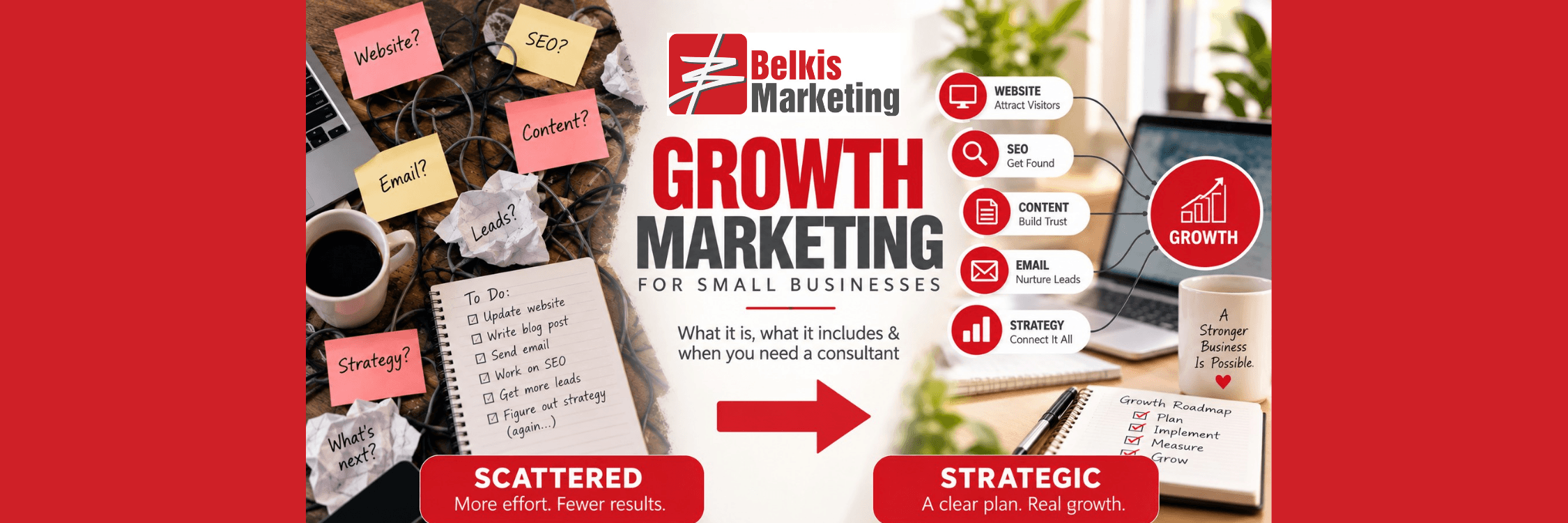
Growth Marketing for Small Businesses: What It Is, What It Includes, and When You Need a Consultant
If you own a small business, you probably don’t need more marketing advice telling you to “post more,” “run ads,” or “get on social media.” You need to know what is actually going to help your business grow.
That’s where growth marketing comes in.
Growth marketing takes a broader view of your marketing. Instead of focusing on one channel or chasing individual tactics, it looks at the entire customer journey—from how someone discovers your business to what convinces them to become a lead, how you follow up, and what ultimately turns that lead into a customer.
For small businesses, this can be especially valuable because you don’t have unlimited time, money, or people. You need your marketing efforts to work together.
What Is Growth Marketing?
Growth marketing is a strategic approach to marketing that focuses on the entire process of attracting, converting, and retaining customers.
Traditional marketing often focuses heavily on awareness: How many people saw your ad? How many people visited your website? How many followers did you gain? Growth marketing asks a bigger question:
Is your marketing actually helping your business grow? That means looking at the full customer journey. For example:
Visibility → Website → Trust → Lead → Follow-Up → Customer → Repeat Business
If something is breaking down along that journey, growth marketing looks for the problem and determines what needs to change. Maybe people are finding your website through Google, but your website isn’t clearly explaining what you do. Perhaps your website looks professional, but visitors don’t know what to do next or you’re generating leads but aren’t following up consistently. Perchance, you’re creating content every week but none of it is attracting the people who are actually likely to become customers.
Growth marketing connects those pieces.
What Does a Growth Marketing Consultant Do?
A growth marketing consultant helps a business identify opportunities and problems across its marketing ecosystem and develop a strategy for improving growth.
Rather than immediately recommending another marketing channel, a good consultant starts by asking:
- Who are you trying to reach?
- What are your customers searching for?
- How are people currently finding your business?
- Is your website converting visitors into leads?
- Can potential customers quickly understand what you offer?
- Are you showing up in search results?
- Is your content answering your customers’ questions?
- Are you following up with leads?
- What marketing activities are actually producing results?
- Where are potential customers dropping off?
The goal isn’t to do more marketing simply for the sake of doing more. The goal is to make the marketing you are already doing work harder.
What Does Growth Marketing Include?
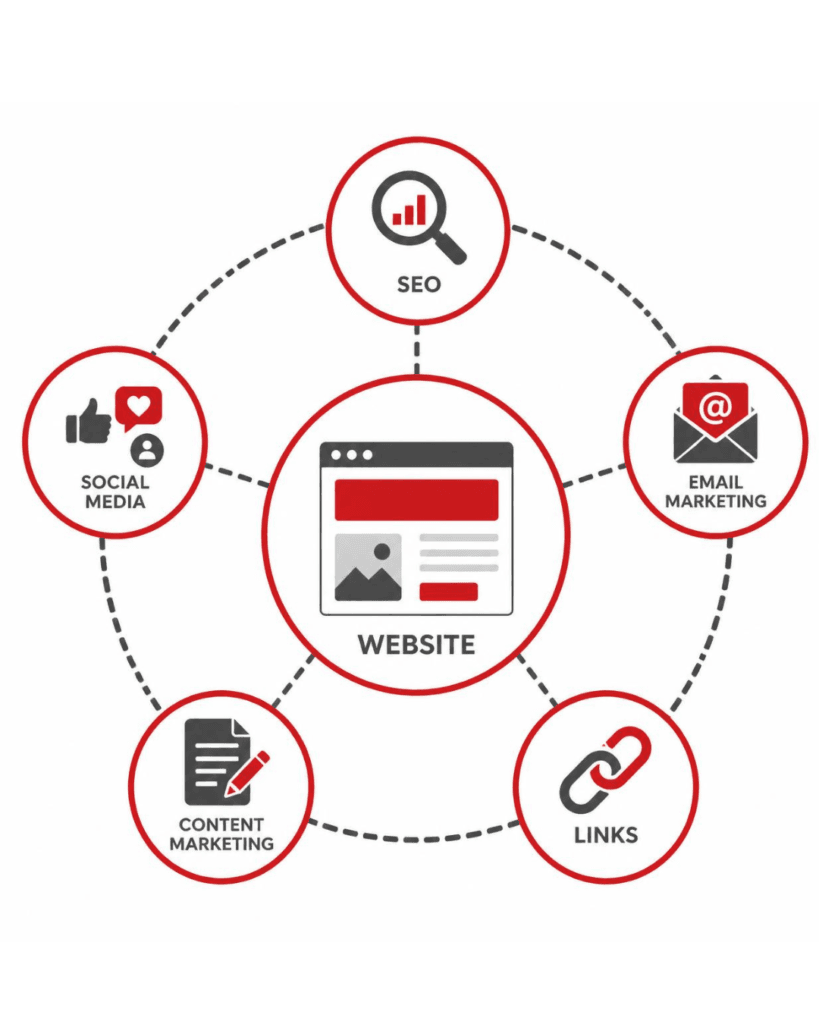
Growth marketing can include many different disciplines because growth rarely comes from one isolated tactic. For a small service-based business, a growth marketing strategy may include:
1. Website Strategy
Your website is often the center of your digital marketing. If someone finds you through Google, a referral, social media, an email, or an advertisement, they may eventually end up on your website. That’s why your website needs to do more than look good. It needs to:
- Clearly explain what you do
- Speak to the right audience
- Establish trust
- Answer important questions
- Make your services easy to understand
- Give visitors a clear next step
- Make it easy to contact or hire you
A beautiful website that doesn’t generate inquiries is still a marketing problem.
2. Search Engine Optimization (SEO)
SEO helps potential customers find your business when they’re searching for the products or services you provide. For a small business, SEO might include:
- Keyword research
- On-page SEO
- Local SEO
- Service-page optimization
- Blog content
- Internal linking
- Search intent analysis
- Google Business Profile optimization
- Technical SEO recommendations
But SEO shouldn’t be treated as simply “adding keywords to a website.” Effective SEO starts with understanding what your potential customers are actually looking for and creating useful content and pages that satisfy that intent.
3. Content Marketing
Content gives your business an opportunity to answer questions before someone ever contacts you. For example, a potential client might search:
“How much does SEO cost for a small business?”
“Why isn’t my website generating leads?”
“Do I need SEO if I already have referrals?”
Creating useful content around those questions can help you become visible while simultaneously demonstrating your expertise. That’s much more valuable than publishing blog posts simply because someone told you that “you need a blog.”
4. Email Marketing
Getting someone to visit your website is only part of the equation. What happens if they aren’t ready to buy today? Email marketing gives you a way to continue the relationship. Depending on the business, that might include:
- Lead-nurture sequences
- Newsletters
- Educational emails
- Follow-up campaigns
- Promotional campaigns
- Customer retention emails
For many small businesses, email can be one of the most overlooked opportunities because they focus so heavily on acquiring new audiences instead of nurturing the people who have already shown interest.
5. Conversion Strategy
Traffic isn’t the same thing as growth. You can have thousands of website visitors and still have a lead-generation problem. Conversion strategy looks at what happens after someone arrives.
Are your calls to action clear?
Are your contact forms easy to use?
Does your website communicate why someone should choose you?
Are there too many distractions?
Is there enough information to build trust?
Are visitors being given an obvious next step?
These questions can uncover opportunities to improve results without necessarily increasing your marketing budget.
These are the core areas I focus on at Belkis Marketing. Explore my marketing services to see how I help small businesses strengthen their website, SEO, content, and email marketing.
Why Is Growth Marketing Especially Useful for Small Businesses?
Large companies often have entire teams dedicated to SEO, content, paid advertising, email, analytics, and conversion optimization. Small businesses usually don’t.
You may be the owner, salesperson, customer service representative, and marketing department all at once. That means your biggest challenge isn’t necessarily a lack of marketing ideas. It may be knowing which ideas deserve your time and money.
A growth marketing approach helps you prioritize.
Instead of asking:
“What should I post this week?”
You can ask:
“What is the biggest obstacle preventing my business from getting more qualified leads?”
Those are very different questions. And the second question is much more likely to lead to meaningful growth.
When Should a Small Business Hire a Growth Marketing Consultant?
You may want to consider working with a growth marketing consultant if:
- Your marketing feels scattered. You’re doing a little SEO, posting on social media, sending an occasional email, and publishing content—but none of it feels connected.
- Your website gets traffic but few inquiries. People are visiting, but they’re not taking the next step. That may indicate a conversion, messaging, positioning, or trust problem.
- You’re getting referrals but want a more predictable source of leads. Referrals are wonderful, but relying entirely on word-of-mouth can make growth unpredictable. SEO, content, email, and website strategy can help create additional paths to your business.
- You’re spending money on marketing without knowing what’s working. If you’re investing in advertising, content, SEO, or other marketing activities but aren’t sure what is producing results, it’s time to step back and evaluate the strategy.
- You know something needs to change – but don’t know what. Sometimes the most valuable thing a consultant can provide isn’t another marketing tactic. It’s an outside perspective. A consultant can look at your business objectively, identify opportunities you may not see, and help you determine what to prioritize first.
Growth Marketing vs. Hiring an SEO Consultant
This is an important distinction. An SEO consultant primarily focuses on helping your business improve its visibility in search engines. A growth marketing consultant looks at the bigger picture.
SEO might be one part of the strategy—but the consultant may also evaluate your website, messaging, content, lead generation, email marketing, conversion process, and overall customer journey.
Neither approach is inherently better. It depends on the problem you’re trying to solve. If your website is already converting well but you’re struggling to get found in Google, SEO may be exactly what you need. If you’re getting traffic but very few leads, the problem may be somewhere else. And if you aren’t sure where the problem is, a broader growth assessment can be a better place to start.
What Should You Look for in a Growth Marketing Consultant?
Before hiring someone, look beyond a list of services. Ask how they approach strategy. A good growth marketing consultant should be able to:
Look at the whole picture.
They should understand how your website, SEO, content, email, and lead generation work together.
Prioritize.
You shouldn’t leave a consulting engagement with a list of 75 things you need to fix tomorrow. You should understand what matters most and why.
Explain the “why.”
You shouldn’t need a marketing degree to understand the recommendations you’re paying for.
Connect marketing activity to business goals.
More traffic isn’t necessarily the goal. More qualified leads, customers, revenue, or retention may be.
Work with your resources.
A strategy for a 10-person company with a $20,000 monthly marketing budget isn’t necessarily appropriate for a solo business.
Most importantly, your consultant should help you understand what to do next.
Growth Marketing Doesn’t Mean Doing Everything
This is one of the biggest misconceptions about growth marketing. A growth strategy doesn’t mean your business needs to be everywhere. You don’t necessarily need:
- Every social media platform
- A weekly podcast
- Paid advertising
- Daily blog posts
- Five email campaigns a week
- A complicated marketing funnel
You need to identify the opportunities that make the most sense for your business, your customers, and your goals. Sometimes the biggest growth opportunity is improving a service page, fixing your website’s messaging, investing in local SEO, creating a lead magnet and email sequence. Perhaps, the answer is simply to stop doing things that aren’t producing results.
Growth Starts With Finding the Leaks
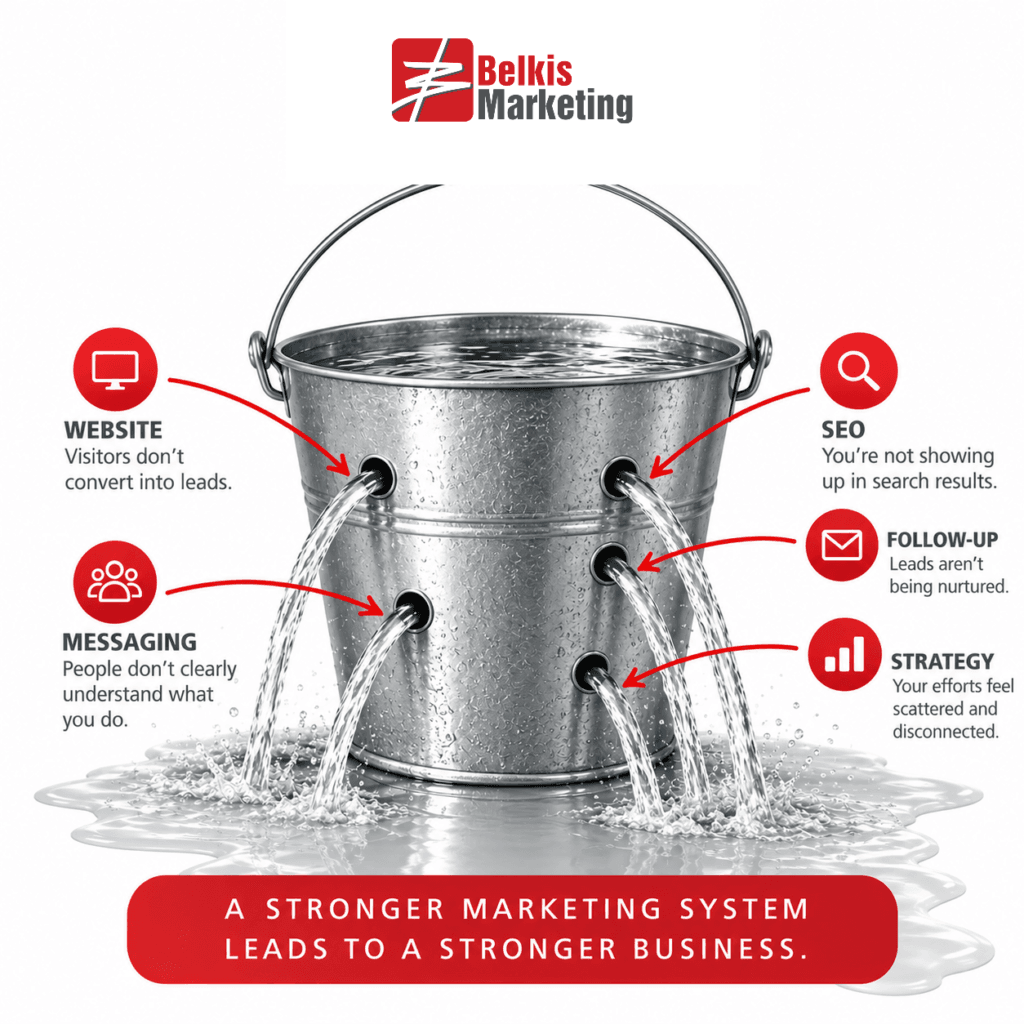
Before you pour more traffic into your marketing system, you need to know whether the system is working. Think of your marketing like a bucket. If the bucket has holes, adding more water isn’t going to solve the problem. The same is true for marketing.
If your website isn’t converting, sending more visitors won’t necessarily fix it. Your offer may not be clear so creating more content won’t necessarily fix it. Assuming you’re not following up with leads, generating more leads may simply create more missed opportunities.
Growth marketing looks for those leaks first. That’s why I believe small businesses should focus on strategy before simply adding more tactics.
Not sure where your marketing is leaking? Start with my 30-Minute Growth Audit. It’s a quick way to identify potential gaps in your website, visibility, content, conversion, and overall marketing strategy.
Do You Need a Growth Marketing Consultant?
If you’re a small business owner in South Carolina—or anywhere else—and you’re struggling to figure out what your marketing needs next, you don’t necessarily need another marketing package. You may need a clear strategy. That’s where I come in.
I’m Belkis Cardona-Rivera, a growth marketing consultant and the founder of Belkis Marketing. I help small businesses identify what’s working, what’s getting in the way of growth, and where to focus their marketing efforts next. My approach centers on four core areas:
- Website Strategy
- SEO
- Content Marketing
- Email Marketing
Rather than starting with a one-size-fits-all marketing package, I start by looking at the bigger picture. Because before you invest more time or money into marketing, you should know where your biggest growth opportunities are.
If you’re not sure what your business needs next, my Growth Roadmap Consulting service can help you turn that uncertainty into a prioritized plan. You don’t need to do more marketing. You need to do the right marketing.
Frequently Asked Questions
What is growth marketing for small businesses?
Growth marketing is a strategic approach that looks at the entire customer journey—from attracting potential customers to converting and retaining them. It can include website strategy, SEO, content marketing, email marketing, conversion optimization, analytics, and other tactics based on a business’s specific goals.
What does a growth marketing consultant do?
A growth marketing consultant evaluates a business’s marketing ecosystem, identifies opportunities and obstacles, and creates a strategy for improving visibility, lead generation, conversions, and overall growth.
Is a growth marketing consultant different from an SEO consultant?
Yes. An SEO consultant primarily focuses on search visibility, while a growth marketing consultant takes a broader view of the customer journey and may incorporate SEO along with website strategy, content, email marketing, and conversion strategy.
How much does a growth marketing consultant cost?
Consulting fees vary based on the consultant’s experience, the scope of the project, and the complexity of the business. Some consultants charge hourly or by project, while others offer strategic consulting packages or ongoing retainers.
Does every small business need a growth marketing consultant?
No. Some businesses may only need help with a specific area, such as SEO or website optimization. A growth marketing consultant can be particularly helpful when the business isn’t sure where the problem is or how different marketing activities should work together.
How do I know if my marketing is actually working?
Start by connecting marketing activities to measurable business goals. Depending on your business, useful metrics may include qualified website traffic, leads, conversion rate, email subscribers, booked consultations, customers, and revenue—not simply followers or impressions.
Bottom Line
Marketing shouldn’t feel like a collection of random things you’re supposed to keep doing. It should have a purpose.
Your website should support your SEO and your content should answer your customers’ questions. Then your email should nurture your audience. And all of those pieces should ultimately support your business goals. That’s growth marketing.
And sometimes, the smartest next step isn’t doing more. It’s figuring out what needs to happen next.