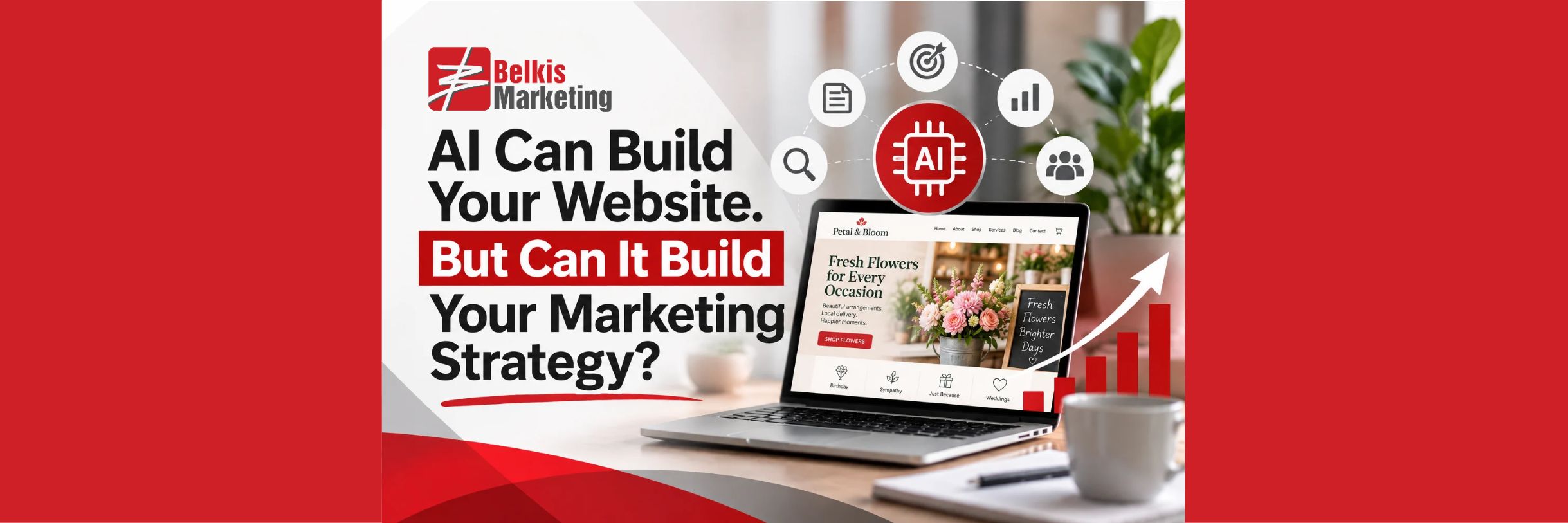
AI Can Build Your Website. But Can It Build Your Marketing Strategy?
AI is changing the way small businesses approach digital marketing. Today, business owners can use AI tools to generate website copy, redesign pages, create blog articles, develop marketing materials, and accomplish tasks that once required significant time and resources and that’s exciting.
For small businesses with limited budgets and busy schedules, AI can be a valuable tool for working more efficiently and exploring new opportunities but there’s an important distinction that many business owners overlook:
Building a website is not the same as building a marketing strategy.
A website can look professional, communicate your services, and reflect your brand but that doesn’t automatically mean potential customers will find it, trust your business, or contact you. If your goal is to generate more leads and grow your business, you need more than a website. You need a marketing system that connects your online presence to your business goals. Let’s look at what that means in an AI-driven digital landscape.
1. AI Is a Powerful Tool, Not a Marketing Strategy
AI can help businesses accomplish an incredible amount of work. It can generate ideas, draft website copy, assist with keyword research, summarize data, and help develop content more efficiently.
However, using AI to complete marketing tasks doesn’t automatically mean those tasks support a larger business objective.
Before creating a website, launching a campaign, or publishing content, you need to answer some fundamental questions:
- Who are you trying to reach?
- What problems are your customers trying to solve?
- Why should they choose your business over a competitor?
- Which services or products are most important to your growth?
- How do your customers find and evaluate businesses like yours?
- What action do you want them to take?
- How will you measure success?
These questions require an understanding of your business, your customers, your market, and your goals. AI can help you explore possible answers, but you still need a clear strategy to determine which direction makes sense for your business.
The goal isn’t to use AI to produce more marketing. It’s to use the right tools to support marketing that has a purpose.
2. A Website Doesn’t Automatically Generate Leads
Imagine spending time updating your website with a modern design, improved messaging, and professional-looking pages. You publish the new site and wait for the inquiries to start coming in. But weeks pass, and the phone isn’t ringing any more frequently than before.
What happened?
The problem may not be the website’s appearance. The issue may be everything that needs to happen before and after someone visits it. Think about the customer journey.
A potential customer first needs to discover your business. They then need to understand what you offer, decide whether you’re a good fit, develop confidence in your business, and know how to take the next step. Your website plays an important role in that process, but it cannot accomplish everything on its own.
A more effective marketing system connects several components:
- Visibility: Helping potential customers discover your business through search engines, local search, useful content, referrals, and relevant advertising.
- Messaging: Clearly communicating what you do, whom you serve, and why customers should consider you.
- Trust: Providing reviews, testimonials, relevant experience, and helpful information that support a customer’s decision.
- Conversion: Making it easy for visitors to request an estimate, schedule a consultation, call your business, or complete another meaningful action.
- Follow-up: Staying connected with prospects who aren’t ready to make a decision immediately.
When these elements work together, your website has a much stronger opportunity to contribute to business growth.
3. Your Website Needs More Than a One-Time Update
Launching a website is an important milestone, but it shouldn’t be the end of your digital marketing efforts. Your business evolves, the services change, and your competitors improve their online presence. In addition, customer expectations shift and search engines update how they present information.
A website that was effective several years ago may no longer reflect your current business goals or the way customers search for services today. This doesn’t mean you need to redesign your website every year. It means you need to evaluate its performance regularly and make improvements when the data and your business goals justify them.
For example, you may discover that:
- Potential customers are searching for services that aren’t adequately represented on your website.
- Visitors are landing on your pages but aren’t submitting inquiry forms.
- Your service pages don’t clearly explain what makes your business different.
- Your local search visibility could be improved.
- Your calls to action are unclear or difficult to find.
- Your website traffic is increasing, but qualified inquiries aren’t keeping pace.
Each of these issues requires a different response. A new design might help in some situations. In others, the better investment could be improved messaging, stronger local SEO, more useful content, or a simpler conversion process. The smartest next step isn’t always rebuilding the website. It’s identifying what is preventing the website from doing its job.
4. SEO Still Matters in an AI-Driven World
As AI changes how people discover and evaluate information, businesses may wonder whether search engine optimization is still worth the investment. The answer is yes, but the approach should focus on more than adding keywords to a page.
Your website needs to communicate clearly what your business offers, whom it serves, and how its services address customer needs. A thoughtful SEO strategy can include:
- Researching the terms and questions your potential customers use when searching.
- Creating useful service pages that match relevant search intent.
- Improving local search visibility.
- Publishing helpful, accurate content.
- Organizing your website so visitors and search engines can navigate it effectively.
- Strengthening internal links between related pages.
- Monitoring search performance and identifying opportunities for improvement.
AI can assist with research, planning, and content development. However, automatically generating large amounts of content isn’t a substitute for demonstrating relevant knowledge, providing useful answers, and ensuring accuracy. The objective is to create content that genuinely helps your audience while making it easier for the right people to discover your business.
For local businesses, this is especially important. A company serving Myrtle Beach, Conway, and surrounding communities needs to consider how customers search for its specific services in those markets. If you’re a local business owner, read my article on SEO for Small Businesses in Myrtle Beach for more insight into building a stronger search presence.
5. More Website Traffic Doesn’t Always Mean More Customers
Another common misconception is that more traffic automatically produces more leads. Traffic is important, but not all traffic has the same value.
A thousand visitors who aren’t looking for your services may be less valuable than 50 visitors who are actively searching for what you offer. This is why marketing needs to consider both attracting visitors and helping the right visitors take action.
For example, if you’re a painting contractor, attracting people searching for painting tutorials may not produce the same business value as attracting homeowners who are actively looking for a professional painter. Your content, landing pages, calls to action, and advertising should align with the needs and intent of your ideal customers.
You also need to measure the results. Depending on your business, useful metrics may include:
- Qualified inquiries.
- Phone calls and estimate requests.
- Conversion rate.
- Cost per lead.
- Lead quality.
- Sales generated.
- Revenue attributable to marketing.
Website traffic, page views, and keyword rankings can provide valuable context, but they shouldn’t be the only measures of success. The real question isn’t simply how many people visited your website. It’s whether your marketing is helping you reach the right people and move them closer to becoming customers.
6. Why Paid Advertising Should Be Part of a Strategy
AI tools can help businesses create ad copy, brainstorm headlines, and develop campaign ideas. Advertising platforms can also automate parts of campaign delivery and optimization. These capabilities can be useful, but they don’t eliminate the need for planning.
Before investing in paid advertising, consider whether you have:
- A clearly defined target audience.
- A service or offer that addresses a specific customer need.
- A landing page that supports the ad’s message.
- A clear and compelling call to action.
- Appropriate conversion tracking.
- A process for responding to inquiries.
- A realistic budget and a plan for evaluating performance.
You don’t necessarily need a perfect website before launching an advertising campaign. In some cases, a focused landing page and a well-designed test can help you learn what resonates with potential customers. However, you should understand what you’re trying to accomplish and how you’ll determine whether the campaign is working.
Sending paid traffic to a website without a clear conversion strategy can make it difficult to understand why a campaign is or isn’t producing results. Paid advertising can accelerate a well-planned approach, but it shouldn’t be expected to compensate for every weakness in the marketing process.
7. The Best Approach Combines AI With Human Strategy
This isn’t an argument against AI. In fact, I believe small businesses should explore how AI can help them work more efficiently and make better use of their resources. AI can support many marketing activities, including:
- Brainstorming content topics.
- Drafting and refining website copy.
- Organizing keyword research.
- Developing content outlines.
- Analyzing performance reports.
- Identifying questions customers frequently ask.
- Exploring campaign ideas.
- Streamlining repetitive tasks.
But these tools work best when guided by clear business objectives and reviewed for accuracy, relevance, and quality. Someone still needs to determine which opportunities deserve attention, whether the recommendations align with business priorities, and how the different activities should work together.
For example, an AI tool might help you generate 30 blog post ideas. A strategy determines which topics are most relevant to your ideal customers, which support your services, which have realistic search opportunities, and how each article fits into your broader marketing plan.
The same principle applies to website development, SEO, email marketing, and paid advertising. AI can help you execute. Strategy helps you decide what to execute, why it matters, and how to evaluate the results.
8. Build a Marketing System, Not Just a Website
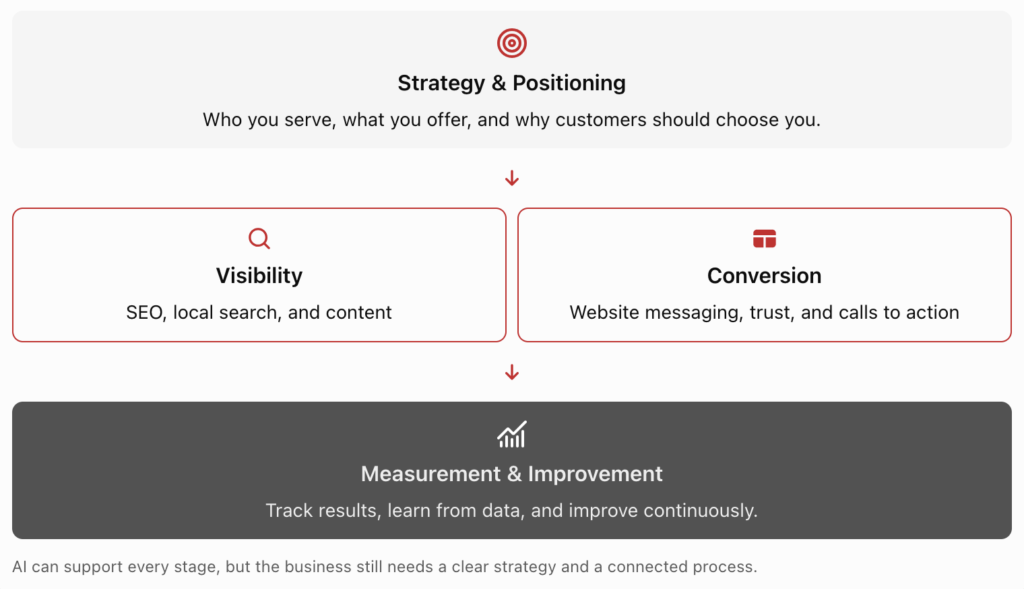
A sustainable digital marketing approach connects multiple activities around a common goal.
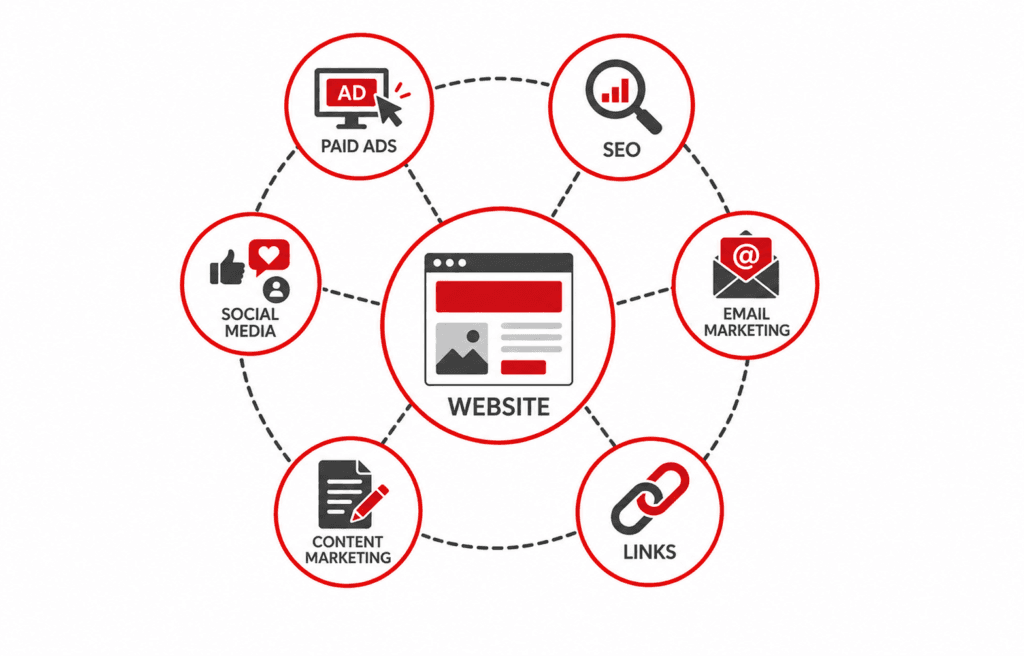
Depending on your business, that system might include:
- Strategy and positioning: Establishing your audience, services, competitive advantages, and growth priorities.
- Website and conversion optimization: Making sure your online presence clearly communicates your value and gives visitors a straightforward path to becoming customers.
- SEO and search visibility: Helping relevant audiences discover your business when they’re looking for solutions.
- Email marketing (lead nurturing): Following up with prospects through appropriate channels, including email, when they need more time or information before making a decision.
- Content marketing: Publishing helpful information that answers customer questions, demonstrates expertise, and supports the customer journey.
- Social media: organically promote your website, articles, guides, lead magnet, etc.
- PR and link building: build high-authority and credibility from reputable sites and media outlets
- Paid advertising: Reaching targeted audiences and testing opportunities when the campaign objectives, budget, and measurement approach are clear.
- Measurement and improvement: Reviewing results, learning from customer behavior, and adjusting your marketing based on evidence.
These activities don’t all need to happen at once. In fact, trying to do everything simultaneously can stretch a small business’s time and budget too thin. The key is determining what matters most right now, what should happen next, and how each activity contributes to your larger goals. That’s how you move from disconnected marketing tasks to a coordinated system designed to support growth.
Where Should Your Business Start?
If you’ve recently used AI to build or update your website, congratulations on taking steps to improve your online presence. Now is a good time to ask a few questions:
- Can my ideal customers easily find my business online?
- Does my website clearly communicate what makes my business valuable?
- Are visitors taking the actions I want them to take?
- Do I have a plan for creating useful content and maintaining search visibility?
- Am I tracking inquiries and evaluating the results of my marketing?
- Do I know which marketing activities deserve my attention and budget first?
You don’t need to have every answer immediately. What you do need is a clear understanding of your current position and a practical plan for moving forward. Before investing in another website redesign, adding more AI tools, or launching paid advertising, take a step back and evaluate the bigger picture. You may discover that your business doesn’t need more marketing activity. It needs a better way to connect the activities you’re already doing.
Ready to Turn Your Marketing Into a Growth Strategy?
I help businesses look beyond individual marketing tasks to understand how their website, SEO, content, and other digital marketing activities can work together to support business growth.
My Growth Roadmap is designed to help you identify opportunities, uncover gaps, prioritize your next steps, and build a practical plan around your business goals. Instead of guessing what to fix next or investing in marketing activities without a clear direction, you’ll have a strategy to guide your decisions. Because your business deserves more than a website that simply looks good. It deserves a marketing strategy built around where you want to go.
Explore the Belkis Marketing Growth Roadmap and discover how a more connected marketing approach can help your business move forward.